Politicians -You dont even have to like them

In case you didn’t know, there’s an election here in NZ in a few weeks time.

It’s tempting to just ignore it and not bother voting, but then that could mean the ‘wolves’ get voted in, and for the ‘sheep’, lamb is back on the menu.. 

Below is an article from one of the founders of Voices For Freedom.
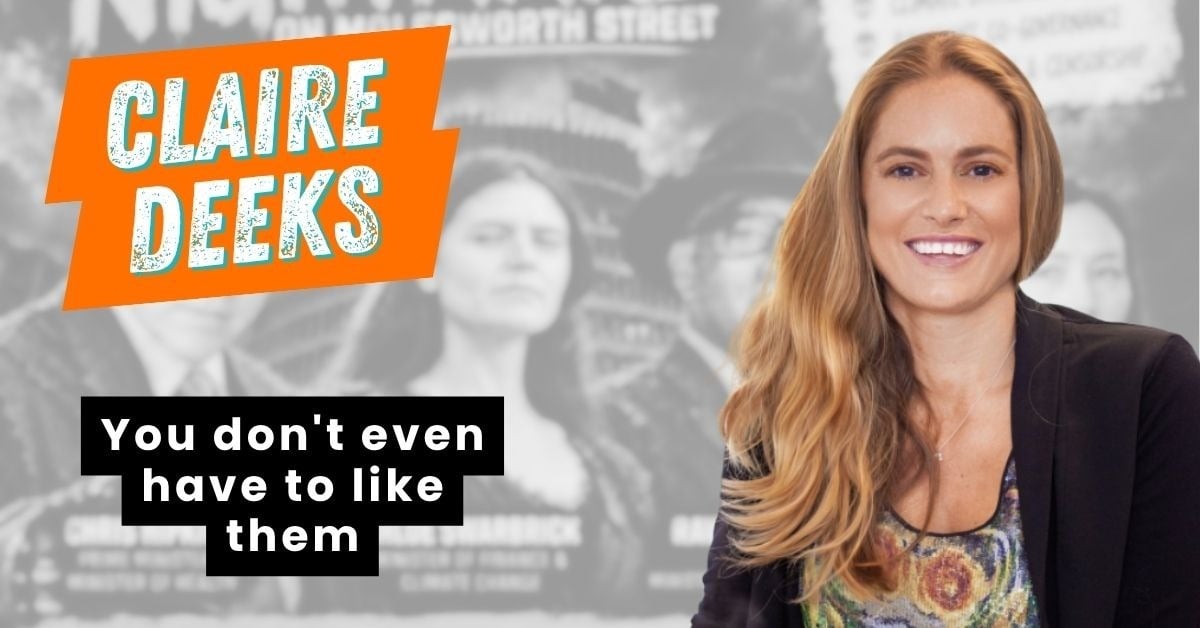
You don’t even have to like them

You don’t even have to like them

16 October 2026

by Claire Deeks

With the election just a few weeks away, there’s something I want to talk about.

I’ve heard from people who have decided they won’t be voting this year. Others are still trying to work out who, if anyone, deserves their vote.

And I understand why.

After everything we’ve experienced over the past six years, it’s hardly surprising that so many New Zealanders have lost faith in politicians and the political system.

When Alia, Libby and I started Voices for Freedom back in 2020, we were three mums who were deeply concerned about what was happening to our country and what it meant for our families. We had no idea what lay ahead. We certainly didn’t expect to find ourselves doing what we’re doing today!

But we knew that staying quiet wasn’t an option. And so did the thousands of New Zealanders who joined us. Together, we’ve challenged government decisions, asked difficult questions, supported one another, built communities and created our own independent media platform.

We’ve had our fair share of disappointments along the way. But we’ve also seen what can happen when enough ordinary people refuse to give up.In fact, we’ve just had another reminder of that.

This week, New Zealand was one of only two countries to abstain from a United Nations vote on a declaration concerning pandemic preparedness. Foreign Minister Winston Peters made the decision, citing concerns about protecting New Zealand’s sovereignty and our ability to make our own decisions about public health.

And the reaction has been quite something! Former Prime Minister Helen Clark called it “humiliating”. Chris Hipkins described it as an embarrassment.

Well, I see something rather different.

For years, people like us have been raising concerns about the WHO, international health agreements and the importance of keeping decisions about New Zealand in New Zealand.

And here we have a political party taking a position on the international stage that reflects some of those concerns, despite considerable pressure to fall into line.

That matters. And I think we should recognise it.

You don’t have to agree with everything Winston Peters says or does to appreciate this particular decision. You don’t even have to like the man!

We should still question him, challenge him and hold him accountable, just as we should every other politician. But this is a timely reminder that political pressure, public scrutiny and persistent voices can make a difference.

And that brings me back to the election.

I know many of you feel there is no party that truly represents your views.I share plenty of those frustrations. But I worry about good people becoming so disillusioned that they decide there’s simply no point in participating.

Because the decisions made in Parliament will affect us whether we vote or not. They will affect our families, our businesses, our freedoms and the opportunities our children have in the years ahead. And as we’ve learned the hard way, the people making those decisions matter.

We don’t have to find a perfect political party to recognise that some outcomes may be better than others.

Nor does voting mean giving anyone a free pass. Whoever forms the next government, our job remains the same. We keep asking questions. We keep speaking up. We keep holding them to account. That’s what Voices for Freedom has always been about.

So, if you’re thinking about sitting this election out, I’d encourage you to give it some more thought. Look carefully at the options. Consider what matters most to you, what each party has actually done, and what the possible election outcomes might mean for New Zealand.

And please, take the time to understand how MMP works. Your party vote and electorate vote do different jobs, and the way our electoral system operates can produce some surprising results. We’ve put together some resources to help explain all of this, and I hope you’ll find them useful. 

Whatever you decide on election day, I hope you make that decision from a position of knowledge and conviction, rather than frustration or resignation.

Six years ago, we decided that our voices mattered enough to stand up and use them.

I still believe that today. And I hope you do too.
What is a Woman?

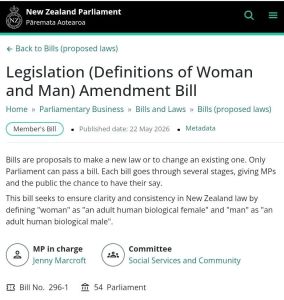
I’ve put a submission in recently, for a bill before NZ’s parliament to define what a man and a woman is..

Now, it’s pretty obvious to me , and I would of thought, obvious to everyone else, what a man and a woman is, it’s just simple biology.

But since we now have 60+ genders out there apparently, it’s all got a bit confusing for some, including Chris Hipkins, who can’t tell us what a woman is (he was married to one)

Chris hopes to be Prime Minister in a 5 months time…

https://m.youtube.com/watch?v=6OGe9RAmFWw

So here we are ‘defining’ what I thought would be obvious, but here we are.

Below is a sample template from VFF (Voices For Freedom)

I support the Bill for the following reasons:

1. Legal certainty
Laws should be clear and consistent.
If Parliament continues to use terms such as woman, man, female, and male throughout legislation, those terms should have clear legal definitions.
Without clear definitions, courts, government agencies, schools, sporting organisations, employers, and service providers may interpret these terms differently.
Clear definitions help ensure laws are applied consistently and as Parliament intended.
2. Women’s rights and protection
It is important that biological sex remains clearly recognised in law where rights, protections, privacy, dignity, safety, or fairness depend upon it.
Many laws, policies, and services distinguish between the sexes.
Examples include women’s health services, maternity provisions, women’s sport, changing facilities, correctional facilities, and safeguarding policies.
3. Privacy, dignity and safety
Many women and girls have concerns about privacy, dignity, and safety in situations where biological sex may be relevant.
Clear definitions help decision-makers understand when sex-based provisions apply and how they should be administered consistently.
Parliament should provide clarity rather than leave these questions to ongoing disputes and litigation.
4. Women’s sport
Biological differences between males and females can affect fairness in sport.
I support maintaining clear sex-based sporting categories and believe legal clarity regarding biological sex assists sporting organisations when making policies and decisions.
5. Healthcare and data
Accurate health information relies on accurate sex-based data.
Biological sex can be relevant to medical research, health outcomes, screening programmes, reproductive health, and public health statistics.
Clear definitions support the collection of accurate health information and evidence-based policy.
6. The rule of law
The law should be capable of being understood and applied consistently.
Where legal rights and obligations depend upon sex-based classifications, Parliament should clearly define those classifications.
7. Public confidence
Many New Zealanders are confused about how the terms woman and man are currently interpreted in law.
Clear definitions would help improve transparency, consistency, and public confidence.
Parliament should provide clarity rather than leave fundamental legal terms open to competing interpretations.
8. My personal perspective
[Insert your own thoughts here. Totally optional]

Examples include:

why this issue matters to you;
concerns as a parent or grandparent;
experiences in healthcare, education, sport, or the workplace;
concerns about legal uncertainty;
concerns about privacy, fairness, dignity, or safety;
professional experience relevant to the issue.

RECOMMENDATION:
I support the Definitions of Woman and Man Amendment Bill and recommend that it proceed. I believe clear legal definitions will improve consistency, legal certainty, transparency, and public confidence in New Zealand law.

Thank you for considering my feedback.

NZ’s immigration issue?

Mass migration is becoming a topic here in NZ,  with the recent report in the UK (250,000 girls exploited, 78% of which were done by immigrants apparently), which got reported here.

It’s hard to get an objective view of the UK from the other side of world here in NZ, BTW, but that report doesn’t sound good nevertheless.

Back here in NZ, there’s been a surge of Indian sikh immigrants who proudly managed to get permission to walk around everywhere with ceremonial daggers (kirpan), which obviously nobody else can do.

Sikh event in Rotorua, NZ
photo is courtesy of  Sunlive.co.nz

It’s lead to Brian Tamaki of the Christian Destiny Church making some provocative speeches, which was followed up by the Police deciding to confiscate his guns in what appears to be a political move.

Brian livestreamed the Police coming to confiscate his guns which has the effect of clearly showing the context of what went on.

The Free Speech Union have also released a statement…

https://www.fsu.nz/blog/free-speech-union-if-brian-tamaki-committed-a-crime-prosecute-him-dont-punish-speech-through-the-back-door

It remains to be seen how this all pans out, now that the subject of immigration is now up for debate, with an election about 4 months away.

When the police arrested a woman in Auckland for holding a sign on the sidewalk

Original article is here. https://waikanaewatch.org/#

Now she’s suing them for wrongful arrest: excellent, never let the police get away with abusing your rights. There was far too much police malfeasance during the Jacinda regime, and despite the change of government at that time, it hasn’t ceased as we’ve seen in the Barry Young case.

Continue reading “When the police arrested a woman in Auckland for holding a sign on the sidewalk” →