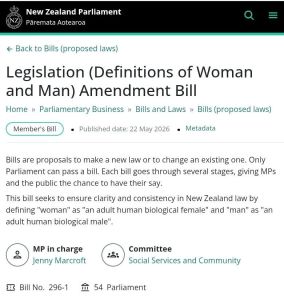
I’ve put a submission in recently, for a bill before NZ’s parliament to define what a man and a woman is..
Now, it’s pretty obvious to me , and I would of thought, obvious to everyone else, what a man and a woman is, it’s just simple biology.
But since we now have 60+ genders out there apparently, it’s all got a bit confusing for some, including Chris Hipkins, who can’t tell us what a woman is (he was married to one)
Chris hopes to be Prime Minister in a 5 months time…
https://m.youtube.com/watch?v=6OGe9RAmFWw
So here we are ‘defining’ what I thought would be obvious, but here we are.

Below is a sample template from VFF (Voices For Freedom)
I support the Bill for the following reasons:
1. Legal certainty
Laws should be clear and consistent.
If Parliament continues to use terms such as woman, man, female, and male throughout legislation, those terms should have clear legal definitions.
Without clear definitions, courts, government agencies, schools, sporting organisations, employers, and service providers may interpret these terms differently.
Clear definitions help ensure laws are applied consistently and as Parliament intended.
2. Women’s rights and protection
It is important that biological sex remains clearly recognised in law where rights, protections, privacy, dignity, safety, or fairness depend upon it.
Many laws, policies, and services distinguish between the sexes.
Examples include women’s health services, maternity provisions, women’s sport, changing facilities, correctional facilities, and safeguarding policies.
3. Privacy, dignity and safety
Many women and girls have concerns about privacy, dignity, and safety in situations where biological sex may be relevant.
Clear definitions help decision-makers understand when sex-based provisions apply and how they should be administered consistently.
Parliament should provide clarity rather than leave these questions to ongoing disputes and litigation.
4. Women’s sport
Biological differences between males and females can affect fairness in sport.
I support maintaining clear sex-based sporting categories and believe legal clarity regarding biological sex assists sporting organisations when making policies and decisions.
5. Healthcare and data
Accurate health information relies on accurate sex-based data.
Biological sex can be relevant to medical research, health outcomes, screening programmes, reproductive health, and public health statistics.
Clear definitions support the collection of accurate health information and evidence-based policy.
6. The rule of law
The law should be capable of being understood and applied consistently.
Where legal rights and obligations depend upon sex-based classifications, Parliament should clearly define those classifications.
7. Public confidence
Many New Zealanders are confused about how the terms woman and man are currently interpreted in law.
Clear definitions would help improve transparency, consistency, and public confidence.
Parliament should provide clarity rather than leave fundamental legal terms open to competing interpretations.
8. My personal perspective
[Insert your own thoughts here. Totally optional]
Examples include:
why this issue matters to you;
concerns as a parent or grandparent;
experiences in healthcare, education, sport, or the workplace;
concerns about legal uncertainty;
concerns about privacy, fairness, dignity, or safety;
professional experience relevant to the issue.
RECOMMENDATION:
I support the Definitions of Woman and Man Amendment Bill and recommend that it proceed. I believe clear legal definitions will improve consistency, legal certainty, transparency, and public confidence in New Zealand law.
Thank you for considering my feedback.


Good for you. I hope your bill is successful. We’ve had politicians in our country try to dodge this question by saying, “I don’t know, I’m not a biologist.” Apparently, they also possess no common sense.
In my opinion, the only confusion this question allows is for that tiny minority of unfortunate individuals born as hermaphrodites. But I’m sure it can be pretty easy to address their situation in any legislation of this type, passed anywhere in the world.
LikeLiked by 2 people