(Steven Hayward) We all know the Great Barrier Reef is in danger of disappearing because of c—— c—–. The climatistas tell us so, at every opportunity: Well guess what Mom? Check in with The Australian (behind a paywall so here is the relevant text—made available by the indispensable Global Warming Policy Foundation): The annual data…
Electric cars have been the ‘in’ thing for some time here in New Zealand. They are mostly favoured by people who either want to make a statement or altruistic people who want to make a difference.
I found that if you talk to an electric car owner, they tend to be biased towards their own car, and it’s therefore hard to get an objective analysis of the pro’s and cons of an electric car vs a petrol one.
I therefore did my own analysis based on what I use a car for. It’s based on buying a new car & keeping it for 5 years or 100,000kms. I’ve used a Nissan Leaf and a Toyota Yaris for this comparision.
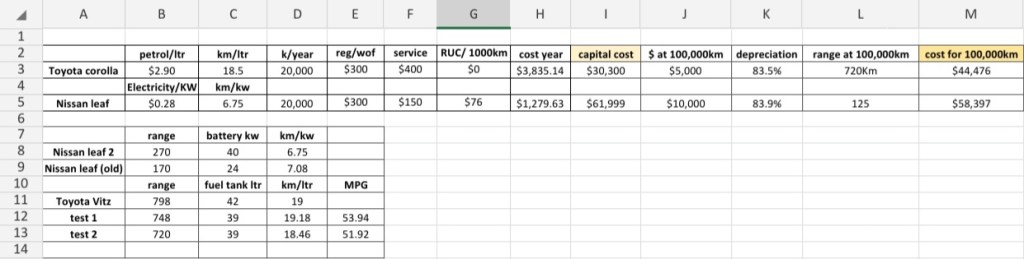
A new Nissan Leaf cost @ $62,000 and has a range of 270Km. An old one with 100,000kms on the clock is worth @ $10,000. Its range will be down to about 125Km. (note 1)
A new Toyota Yaris will cost @ $30,300. an old one with 100,000km’s on it is worth @ $5000.
Electricity costs @ $0.30 per KW. The Nissan Leaf has a range of 270k with a 40KW battery, so it gets @7KM per KW
Petrol costs @ $2.90 a Liter. I use a Toyota Vitz which does about 18.5Km/ltr, and I assume a new Toyota Yaris would be similar in it’s fuel consumption
An electric car has fewer moving parts and the maintenance schedule is mostly about maintaining the brakes, suspension and the wheels, therefore I assume that the yearly maintenance would cost about half that of a petrol car.
A petrol car needs a service once a year, which on average cost me about $400. it is dearer than an electric car because a petrol engine has a lot moving parts in it that can wear out.
If I plug all those numbers into an Excel spreadsheet, I end up with a table as below..
In conclusion, It’s cheaper and more convenient to use a petrol car ($44,476 vs $58,397).
There are free recharge stations setup around New Zealand to accommodate Electric cars, as well as other subsidies to make them more viable. They still have their limitations though, namely a lack of range, a slow recharge time, and forget about towing a boat or caravan. These disadvantages are remarkably similar to CNG (compressed natural gas) which was common in the 1970’s due to the oil crisis. CNG had all but disappeared by the year 2000, and electric cars could do the same if they can’t solve the issues.
Note 1:
Early Nissan Leaf’s had a 24KW battery and a range of 170’ks, old examples of these with 100,000ks on them have a range of about 75k’s. Later versions have a 40KW battery and a range of 270k’s, the power consumption per Km is similar, therefore, I’ve calculated that a later version will have a range of @ 125km when its done 100,000km’s (75*40/24=125)
The link below has a good explanation as to the folly of stressing out about climate change.
Here in NZ, a lot of virtue signalling has been done in the name of climate change. this is underlined by the fact that they are only responsible for 0.1% of worldwide emissions of greenhouse gases.
It’s notable that ‘climate change’ used to be call ‘global warming’. The reason for the name change is that scientists are undecided amongst themselves about whether it will actually cause temperature’s to rise or fall. This in itself shows just how imprecise the science is and begs the question.. Is there actually a problem here at all?
New Zealand’s present government has banned opening of new oil and gas fields, which will lead to energy supply problems in the near future. The present gas supply is due to run out in less than ten years time. It’s not possible to import gas in bulk to get around this problem, as there are no port facilities to handle bulk carriers of gas, and it will take more than ten years to build one in any case. NZ is importing coal, (despite abundant resources of it) to keep one of the major power stations running (Huntly power station -1360 megawatt) which used to run on natural gas, but can’t due to dwindling supplies.
Apparently it’s wrong to mine coal in NZ, but it’s all right if someone else does it in their own backyard.
California is cruising toward a 100% “green” energy future, or so the state’s leaders tell us. But how, exactly, will that objective be brought about? In March of this year, the responsible state agencies issued a plan to achieve 100% carbon dioxide-free electricity by 2045. That is an achievable goal if you use nuclear power. […]




 Uncoffined
You must be logged in to post a comment.