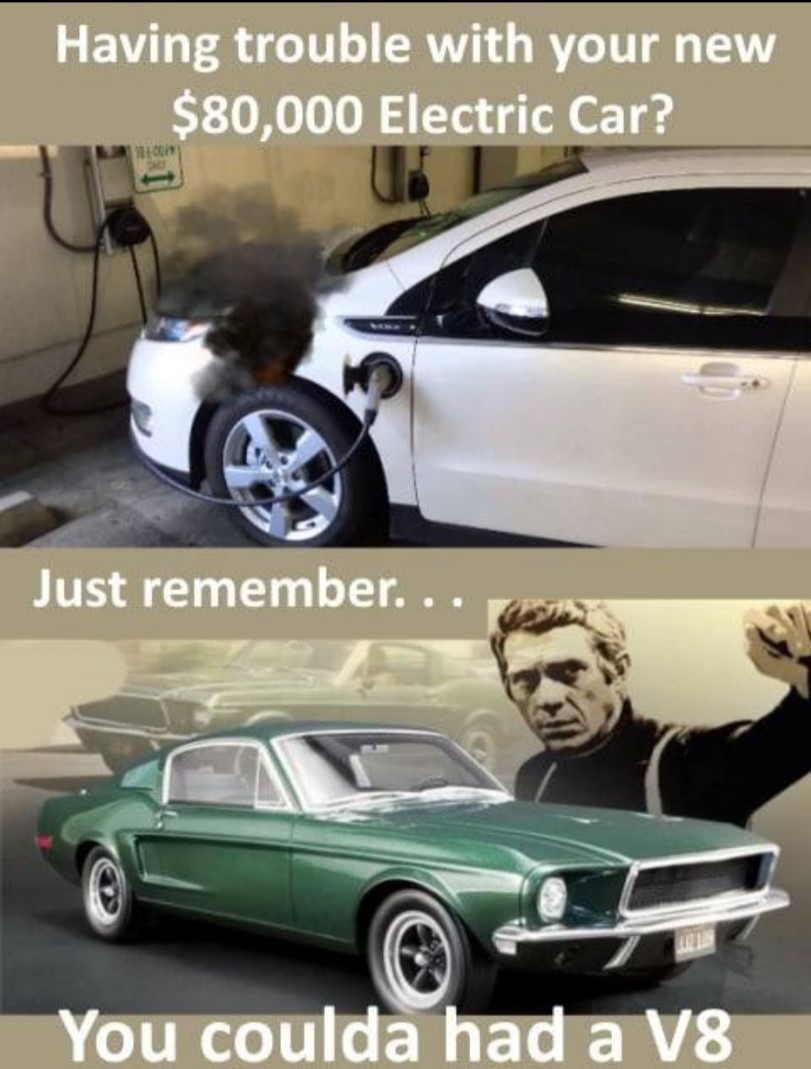

Electric cars have been the ‘in’ thing for some time here in New Zealand. They are mostly favoured by people who either want to make a statement or altruistic people who want to make a difference.
I found that if you talk to an electric car owner, they tend to be biased towards their own car, and it’s therefore hard to get an objective analysis of the pro’s and cons of an electric car vs a petrol one.
I therefore did my own analysis based on what I use a car for. It’s based on buying a new car & keeping it for 5 years or 100,000kms. I’ve used a Nissan Leaf and a Toyota Yaris for this comparision.
A new Nissan Leaf cost @ $62,000 and has a range of 270Km. An old one with 100,000kms on the clock is worth @ $10,000. Its range will be down to about 125Km. (note 1)
A new Toyota Yaris will cost @ $30,300. an old one with 100,000km’s on it is worth @ $5000.
Electricity costs @ $0.30 per KW. The Nissan Leaf has a range of 270k with a 40KW battery, so it gets @7KM per KW
Petrol costs @ $2.90 a Liter. I use a Toyota Vitz which does about 18.5Km/ltr, and I assume a new Toyota Yaris would be similar in it’s fuel consumption
An electric car has fewer moving parts and the maintenance schedule is mostly about maintaining the brakes, suspension and the wheels, therefore I assume that the yearly maintenance would cost about half that of a petrol car.
A petrol car needs a service once a year, which on average cost me about $400. it is dearer than an electric car because a petrol engine has a lot moving parts in it that can wear out.
If I plug all those numbers into an Excel spreadsheet, I end up with a table as below..
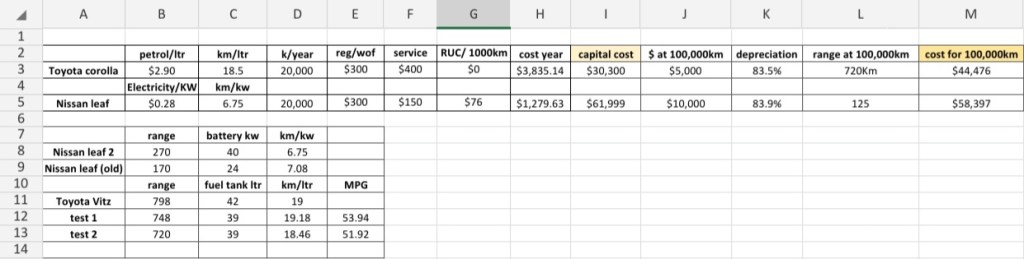
In conclusion, It’s cheaper and more convenient to use a petrol car ($44,476 vs $58,397).
There are free recharge stations setup around New Zealand to accommodate Electric cars, as well as other subsidies to make them more viable. They still have their limitations though, namely a lack of range, a slow recharge time, and forget about towing a boat or caravan. These disadvantages are remarkably similar to CNG (compressed natural gas) which was common in the 1970’s due to the oil crisis. CNG had all but disappeared by the year 2000, and electric cars could do the same if they can’t solve the issues.
Note 1:
Early Nissan Leaf’s had a 24KW battery and a range of 170’ks, old examples of these with 100,000ks on them have a range of about 75k’s. Later versions have a 40KW battery and a range of 270k’s, the power consumption per Km is similar, therefore, I’ve calculated that a later version will have a range of @ 125km when its done 100,000km’s (75*40/24=125)

 Uncoffined
Research appreciated. However, disparities are vanishing quickly, and the move toward mass adoption of electric cars is, coupled with the added component of autonomous driving systems, I believe, a virtual lock at this point. https://www.caranddriver.com/news/g29994375/future-electric-cars-trucks/#:~:text=%20Electric%20cars%20are%20the%20future%2C%20and%20each,new%20names%20such%20as%20Byton%2C%20Lordstown%2C%20and%20Rivian.
LikeLike